
Welsh double-cloth weaving was historically done on handlooms, with the transition to power looms in the 19th century enabling greater consistency and wider distribution. The Caernarfon and Penmachno pattern, like many other traditional designs, has remained in use due to its timeless appeal and historical significance.
Cultural Significance
Welsh blanket designs such as Caernarfon, Penmachno, Pennsylvania patterns have been associated with heritage, craftsmanship, and Welsh identity. These blankets were often given as wedding gifts and were a staple in many Welsh homes. Today, the pattern is still appreciated for its rich history and classic aesthetic.
The Caernarfon Welsh blanket pattern is one of the most recognisable and traditional Welsh tapestry patterns. It originates from North Wales, particularly associated with the Caernarfon area, and is part of the rich tradition of Welsh double-weave blankets.
Design & Characteristics
The Caernarfon pattern features a bold geometric design, often described as a type of “portcullis” or stepped pattern. It is symmetrical and intricate, typically woven in a double-cloth construction, making the blankets reversible. The pattern is commonly seen in strong contrasting colours, such as black and white, red and black, or blue and cream.
Historical Origins
The earliest known examples of the Caernarfon pattern date back to at least the early 19th century, though its roots are likely older. Traditional Welsh weaving flourished in the 18th and 19th centuries, with many local mills producing these blankets. The pattern has been closely associated with the iconic Welsh woollen mills of North and Mid Wales.
The Penmachno Welsh blanket pattern is another traditional Welsh tapestry design, originating from Penmachno, a village in North Wales. Like other classic Welsh weaving patterns, it is part of the double-cloth. tradition, known for its durability, warmth, and intricate geometric designs.
Design & Characteristics
The Penmachno pattern features bold, structured motifs, often incorporating a combination of squares, circular, and stepped elements. It has a slightly more compact and repeating geometric layout compared to the Caernarfon pattern, though both share a similar double-weave construction, making them fully reversible.
Historical Origins
The Penmachno pattern dates back to at least the 19th century, though, like many Welsh patterns, its origins may be much older, drawing inspiration from pre-industrial weaving traditions. Welsh mills, particularly in North Wales, began producing double-weave blankets in large numbers by the mid-to-late 19th century. Penmachno, historically a wool-producing area, had small-scale weavers before larger mills took over the production of Welsh tapestry blankets. The pattern itself became popular in North and Mid Wales, appearing in both blankets and tapestry bedcovers.
The Dinefwr Blanket is the name we have given to this rare and little-documented Welsh pattern, inspired by the noble silhouette of Dinefwr Castle. Its bold, architectural repeat appears to mirror four turrets, while smaller motifs suggest a portcullis, the curve of traditional Welsh lovespoons and even the form of a horse’s bridle — symbols deeply woven into rural Welsh life.
Though little formal record survives, the structured geometry and restrained composition indicate that this may be an early tapestry design, possibly dating to the late 1700s. Like many vernacular Welsh blankets, its full story has been softened by time — yet its presence remains striking, grounded and unmistakably Welsh in spirit.
Design & Characteristics
The Dinefwr pattern features a bold, balanced geometric layout, echoing the strong lines and symmetry found in traditional Welsh tapestry designs but with a softer, contemporary edge. Typically woven in a double-cloth construction, the blankets are fully reversible, offering two colourways in one piece. The design is brought to life in carefully curated colour combinations, from subtle, natural tones to striking contrasts, ensuring it feels at home in both modern and traditional interiors.
Historical Origins
Inspired by patterns historically woven in Wales. While newly created for today’s audience, it carries the spirit of the 18th- and 19th-century Welsh mills, where weaving was central to rural life. The pattern celebrates the enduring link between place, people, and craft, making it both a tribute to the past and a statement for the future.
These blankets typically date back to the late 18th and early 19th centuries, woven in the smaller mills scattered along the Swansea Valley — places like Ystalyfera, Pontardawe, and Clydach. They’re known for their simplicity, utility, and strong aesthetic charm.
Key Features: Stripe Pattern: The defining feature is a broad striped design, usually running across the blanket’s width (sometimes length), often in deep reds, blues, mustards, greens, or natural wool shades. The stripes are usually bold and clear-cut, with some subtle variation in thickness.
Single Layer Weave: Unlike the doublecloth Caernarfon-style blankets, Swansea Valley striped blankets were often plain woven or twill woven — simpler to produce, but still very hard-wearing and warm.
Cultural Notes: They reflect a more understated and practical aesthetic compared to the ornate doublecloth designs. Because of their simplicity, they’re now highly prized by collectors for their clean, minimal design and deep ties to local rural Welsh life. Some people liken them in style to the traditional Carthenni from Carmarthenshire — but with that Swansea Valley colour signature
The Story of Our Craft
Dinefwr Blankets is a young business, but our roots are old.
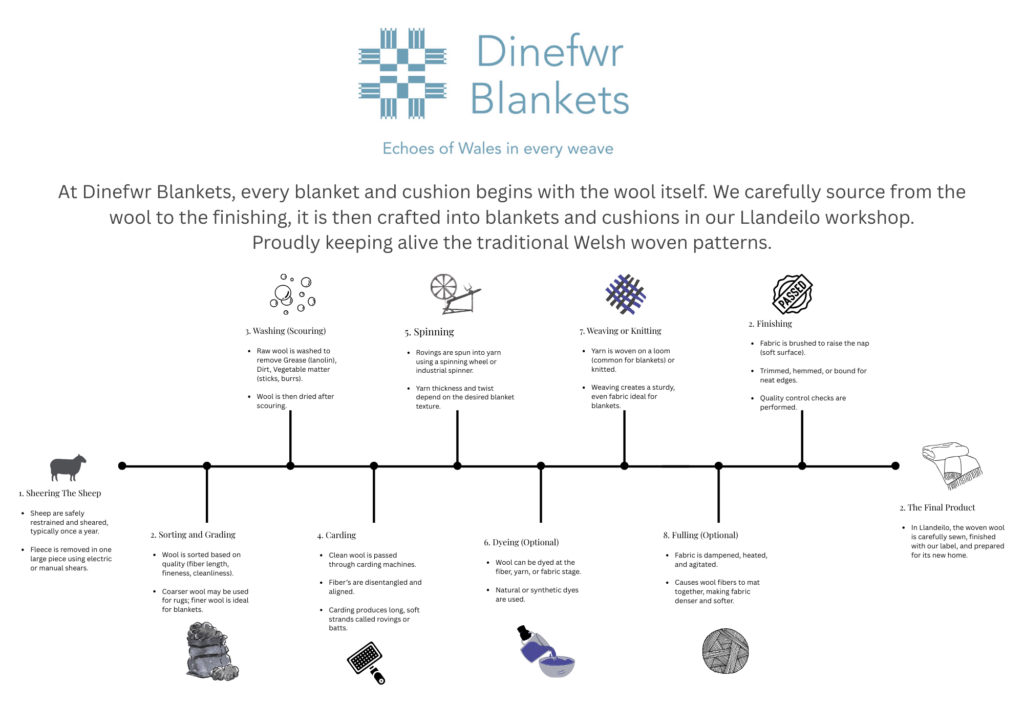
Today, we design new colouways for our blankets here in Wales, finish the cloth in our workshop in Llandeilo, and work with skilled artisan weavers, finishers, carders and spinners in the UK who share our respect for traditional methods, natural materials and proper workmanship.
Our long-term aim is to weave ourselves. We have already purchased four vintage Dobcross looms and care for them with the hope that, in time, they will once again weave cloth here in Wales, as they were built to do, just as our own ancestors once worked at the loom.
Until that day comes, we choose to work with craftspeople whose hands and experience we trust, people who understand that quality takes time and that good cloth should last.
One day, we hope our own looms will be working again. Until then, every blanket we offer is made with care and respect for the traditions we value.